Subject-Independent EEG Classification
This study tests whether an EEG classifier can recognise rest and imagined movements in participants it has never seen during training. We evaluated a four-stream temporal CNN on 16,192 trials from 103 PhysioNet participants, keeping participants separate across training, validation and testing.
The problem
How well does an EEG classifier generalize to participants it has never seen?
The four classes are rest, left-fist imagery, right-fist imagery and both-feet imagery. The classification cohort comprises 103 PhysioNet participants and 16,192 trials.
My role & contributions
I developed the four-stream CNN and implemented nested, participant-disjoint evaluation and reproducibility materials.
Supervision: Dr. Bikash Kumar Pradhan
Method & system
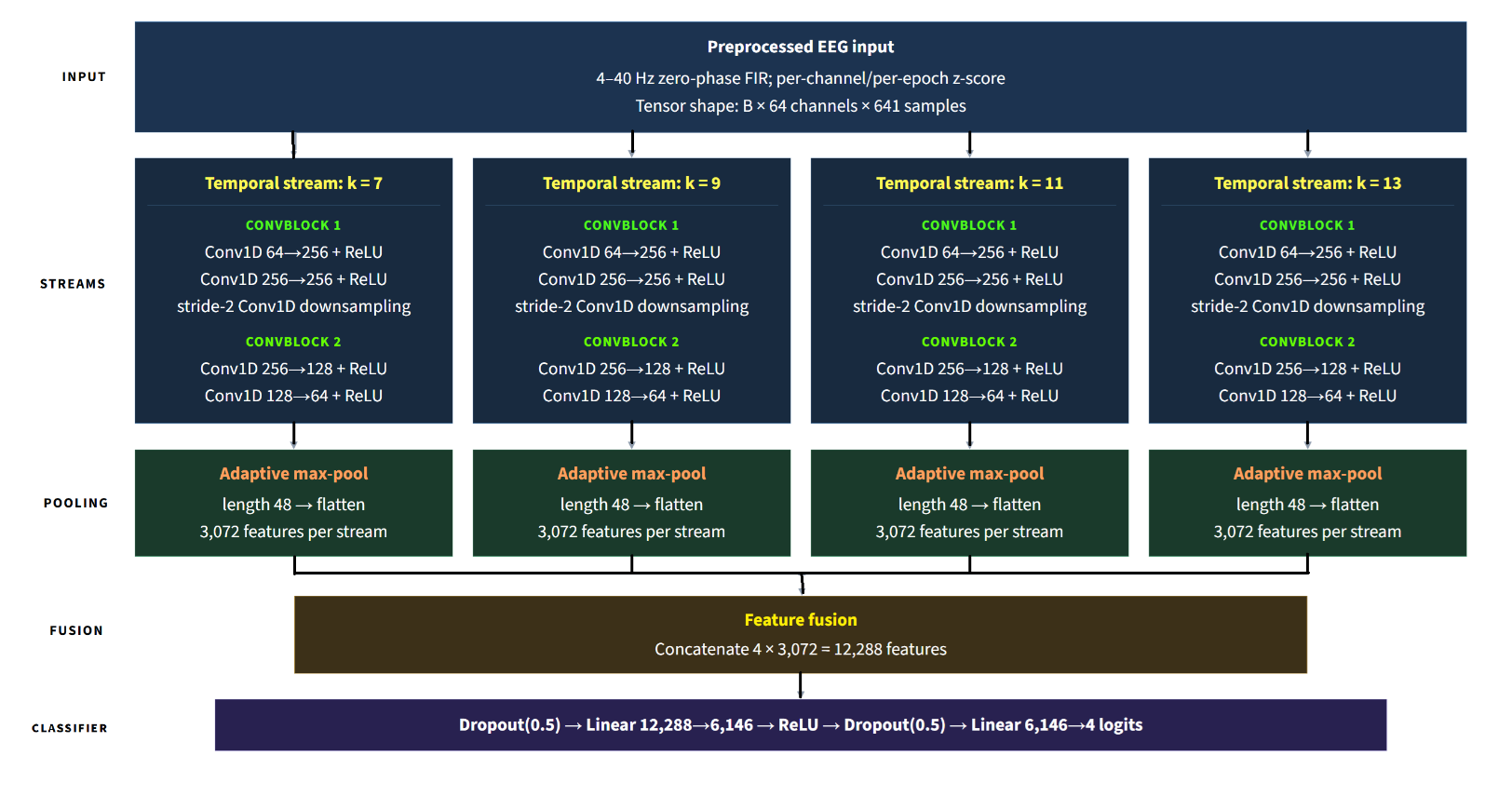 Enlarge figure ↗
Participant-disjoint evaluation
- Outer participant splitKeep outer-test participants separate from outer-training participants
- Inner validationSplit inner-validation participants from the training pool for checkpoint selection
- Model selectionTrain the four-stream Multi-Scale Temporal CNN and select checkpoints using inner validation
- Final outer evaluationEvaluate on untouched outer-test participants; repeat across ten test folds
- Filter 64-channel EEG at 4–40 Hz and normalise each channel within each epoch.
- Process the signals through four parallel temporal convolution streams with kernel widths of 7, 9, 11 and 13 samples. These widths specify temporal scales, not individual brain-frequency bands.
- Combine the four streams’ features for four-class classification.
- Evaluate using nested, subject-disjoint 10-fold cross-validation. Select checkpoints using separate inner-validation participants, never outer-test participants.
Evaluation & results
The reference model has 83.08 million parameters. The results below use seed 42 and report mean ± standard deviation across ten outer folds. Checkpoint selection uses separate inner-validation participants; outer-test participants contribute only to final evaluation.
| Measure | Result | Context |
|---|---|---|
| Accuracy | 70.23 ± 1.87% | Mean ± standard deviation across ten outer folds. |
| Balanced accuracy | 58.38 ± 2.70% | Mean ± standard deviation across ten outer folds. |
| Macro-F1 | 59.70 ± 2.54% | Mean ± standard deviation across ten outer folds. |
Pooled out-of-fold macro one-versus-rest ROC–AUC: 0.839. This pooled ranking measure is reported separately from the fold-mean metrics above.
Across three random seeds, mean accuracy was 69.83 ± 0.36%, with variability measured across the three seed-specific fold means.
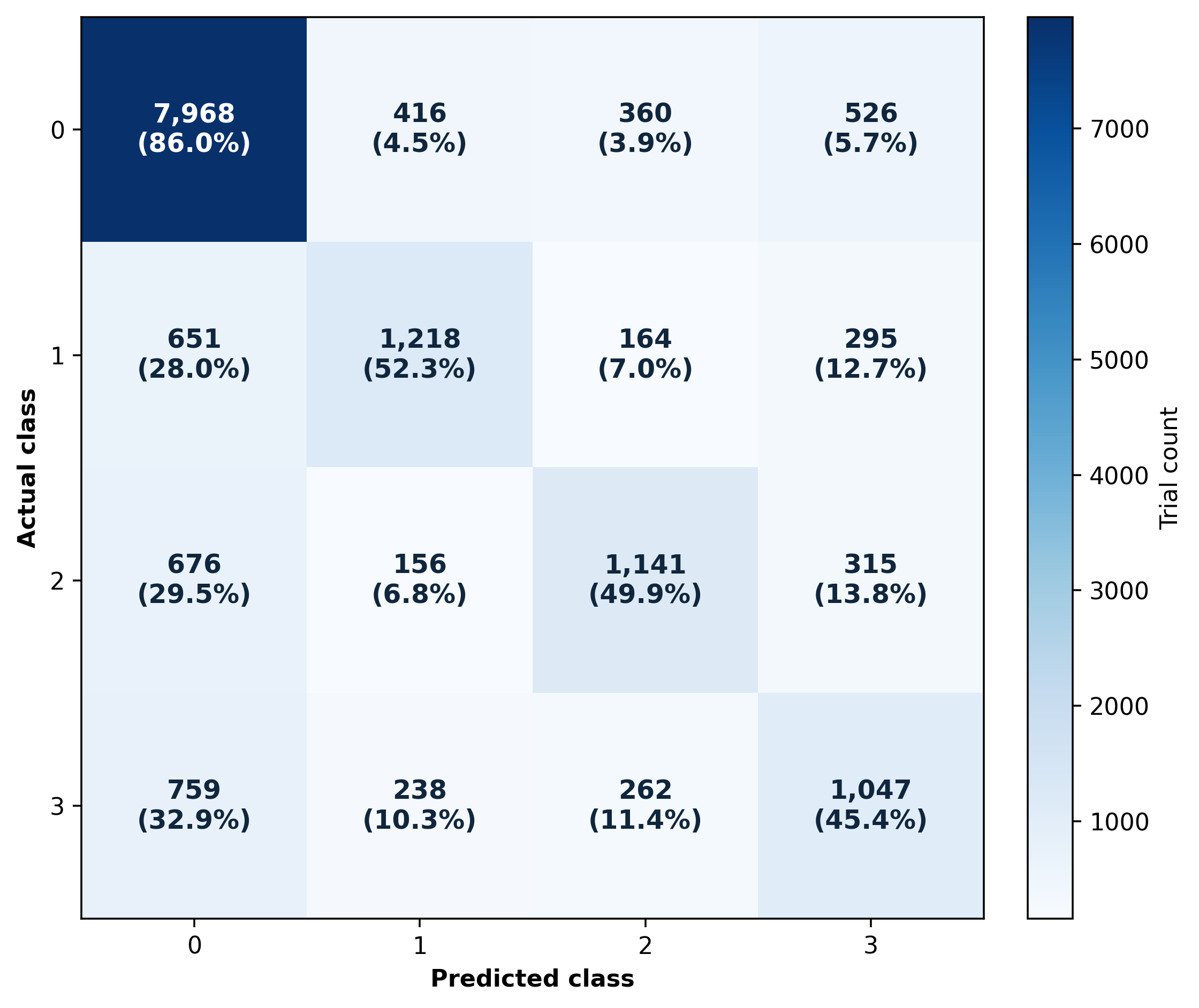 Enlarge figure ↗
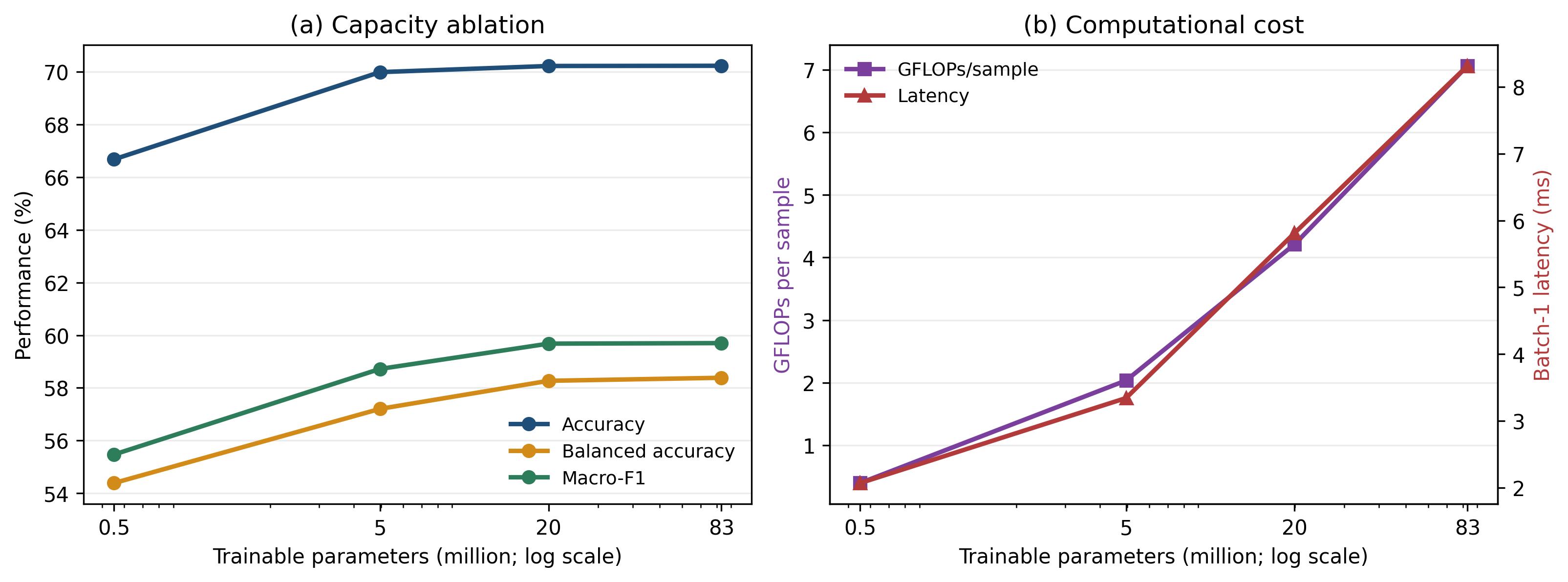 Enlarge figure ↗
Interpretation
Class imbalance and variation between participants affect how overall accuracy should be interpreted; balanced accuracy and macro-F1 provide complementary class-sensitive summaries. A separate neurophysiological band-power analysis included 85 participants after artefact rejection. It provides physiological context, rather than an explanation of the CNN’s decisions, and is distinct from the 103-person classification cohort.
Future work
- Extend evaluation across participants and class distributions, alongside online BCI experiments and clinical validation.