Accuracy on clean mixed-language data
Multilingual speech
LinguaSense
Multilingual speech processing under code-switching and background noise.
The problem
How can a speech system follow language changes when speakers switch languages in noisy environments?
A hybrid RNN–Transformer system combining phonetic language-boundary detection, contextual verification and DeepFilterNet noise suppression. The work began during my exchange at UCSI University and continued at Woxsen.
My role & contributions
I developed the hybrid speech-processing pipeline and integrated noise suppression and 8-bit quantization.
Supervision: Professor Shayla Islam, then Dr. Syed Javeed Pasha
Method & system
LinguaSense architecture
- Speech preparationDeepFilterNet enhancement, audio preprocessing and acoustic features
- Phonetic analysisRNN-based language-boundary detection
- Contextual verificationTransformer-based interpretation of the surrounding language
- Deployment8-bit processing; local initial analysis with cloud verification for complex cases
- Phonetic language boundaries and surrounding linguistic context serve different roles: the RNN tracks short-term changes, while the Transformer checks whether a switch fits its context.
- Noise suppression precedes later acoustic feature extraction so that background sound is reduced before language-boundary analysis.
Implementation details
- DeepFilterNet enhancement and audio preprocessing prepare MFCC acoustic features and temporal segments for the classifier.
- The paper describes 8-bit processing with preprocessing and initial RNN analysis at the edge, and cloud Transformer verification for more complex cases.
Evaluation & results
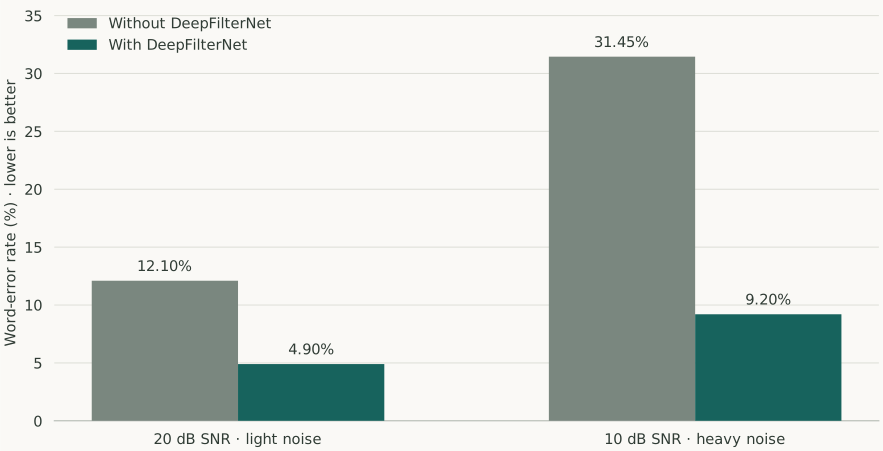
The paper compares system accuracy on clean mixed-language data and at 15 dB SNR. Table III separately compares word-error rate with and without DeepFilterNet under light (20 dB) and heavy (10 dB) noise.
 Enlarge figure ↗
Accuracy at 15 dB SNR
Accuracy follows the paper’s terminology; it is distinct from word-error rate. Source: LinguaSense, Table II.
Accuracy and word-error rate measure different properties and describe the paper’s stated test conditions.
Future work
- Extend evaluation across additional acoustic conditions, keeping accuracy and word-error rate separate.